Costs Per Litre Cleaning Chemicals in Manchester: The Real Maths
Costs Per Litre Cleaning Chemicals in Manchester: The Real Maths
Blog Article
Cost Per Litre Cleaning Chemicals: The Real Maths
Most commercial cleaning budgets leak money. Buyers evaluate products on invoice pack price rather than in-use dilution. A five-litre concentrate drum at twenty pounds appears cheap. A ready-to-use trigger spray at two pounds seems cheaper still. Both assumptions fail under plain arithmetic. Confirming the true cost per litre cleaning chemicals requires computing the yield of working solution, not comparing container sizes.
Ready-to-use formulas compel organisations to transport municipal tap water inside single-use plastic bottles across UK road networks. Meanwhile, unrestricted manual pouring sends valuable concentrate straight down the sink. Are you confident your facilities team pays for active chemical agents rather than bottled water?
Key Takeaways
- Evaluating cleaning chemicals by pack price rather than ready-to-use working solution conceals actual operational spend and distorts extended procurement budgets across all facilities.
- Water constitutes approximately 740ml of usual ready-to-use trigger bottles, meaning organisations pay elevated delivery and packaging rates for pre-bottled tap water.
- Over-concentration by manual free-pouring remains the single largest unnoticed driver of chemical waste, chemical residue build-up, and needless contract expenditure on commercial sites.
- Pre-dosed soluble sachet systems remove measuring errors entirely, setting dilution ratios to ensure consistent compliance standards alongside stable contract expenditure per task.
- Computing chemical yield per application changes floorcare budgeting, cutting mopping expenditure to pennies per bucket and machine scrub tank fills substantially.
In-Use Chemical Costs Across Common Formats
Clear comparisons between chemical formats require standardising prices to the final ready-to-use state. Conventional ready-to-use bottles seem low-cost on a single invoice line. They carry enormous mark-ups per working litre. Concentrated formats and pre-dosed powders shift that balance sharply. They cut the logistical burden of moving water across supply chains.
The table below sets out costs per ready-to-use litre across usual commercial cleaning categories. In practice, list price alone misguides buyers badly. It conceals distribution penalties. It also inflates recurring operational expenses across multi-site UK facilities. Yield is the only figure that enables a sound comparison between formats.
| Product Application | Pack Format and Price | Working Solution Yield | Cost Per Ready-To-Use Litre |
|---|---|---|---|
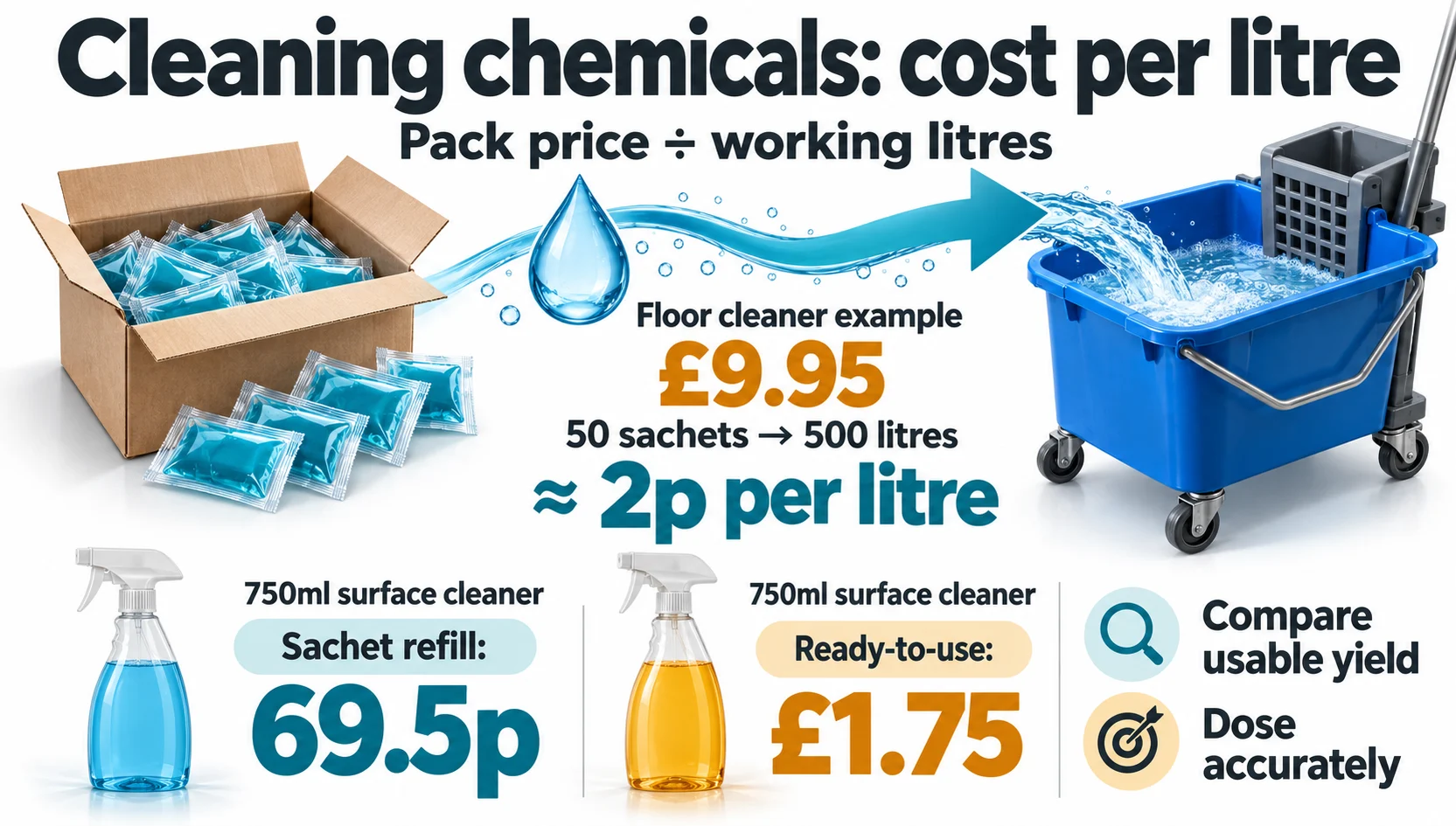
| Hard Surface Floor Cleaner | 50 Sachets (£9.95) | 500 Litres (10L per dose) | £0.020 |
| Washroom Floor Disinfectant | 50 Sachets (£9.50) | 500 Litres (10L per dose) | £0.019 |
| All Purpose Surface Cleaner | 10 Sachets (£6.95) | 7.5 Litres (750ml per dose) | £0.927 |
| Scrubber Dryer Solution | 30 Sachets (£11.95) | 900 Litres (30L per dose) | £0.013 |
| Typical Ready-To-Use Trigger | Single 750ml (£1.75) | 0.75 Litres (no dilution) | £2.333 |
The In-Use Calculation Method
The Working Solution Formula
Working out the true price of cleaning chemistry necessitates a direct three-stage calculation. You divide the total pack purchase price by the number of doses contained. Then you divide that unit dose price by the litres of working solution created. This formula exposes true expenditure instantly.
From experience across the sector, procurement teams asking how to work out cleaning chemical cost per litre forget to account for yield. A fifty-pound drum that makes five hundred litres of working solution costs ten pence per litre. A ten-pound container producing only twenty litres costs fifty pence per litre. Comparing invoice prices alone inverts the actual monetary picture.
Pack Price Versus Delivered Volume
A chemical drum sitting in a janitorial cupboard represents prospective working liquid, not immediate ready-to-use volume. Seeing products through this lens obliges managers to track dilution ratios accurately. High-dilution concentrates offer substantially larger working volumes than sizeable, low-dilution alternatives bought at seemingly keen rates.
When purchasing managers judge chemical options on list price alone, they hurt ultra-concentrated formats. Factoring container yields into purchasing schedules shifts that picture. Greater upfront pack prices regularly deliver the smallest commercial cleaning chemical cost across an entire contract period.
The Hidden Expense of Shipping Water
Ready-To-Use Packaging and Freight Overhead
Ready-to-use cleaning solutions consist almost entirely of standard municipal tap water bottled in plastic. A standard 750ml trigger spray bottle contains roughly 740ml of water and only 10ml of active cleaning ingredients. Moving pre-mixed water across regional distribution networks generates needless carriage, fuel surcharges, and storage overheads.
Every case of ready-to-use spray bottles represents hefty, dead weight on a delivery vehicle. Moving water uses fuel, brings logistics expenses, and necessitates big warehouse staging areas. Facilities paying for pallet deliveries of pre-diluted liquids support the transit of water that flows cheaply from local taps.
Disposal Costs and Packaging Volumes
Ready-to-use bottles cause continuous single-use plastic waste that facilities must store, handle, and pay to remove. Once emptied, the plastic bottle, dipping straw, and trigger head pass into waste streams. Managing these sizeable items lifts commercial refuse disposal charges across operations.
In contrast, concentrated systems minimise rigid packaging. Reusable trigger bottles paired with concentrates stop regular container purchases entirely. Trimming plastic waste volume directly lessens internal handling time, bin store congestion, and total commercial waste management fees.
Did You Know?
Regulation 6 of the Control of Substances Hazardous to Health Regulations 2002 requires a suitable and sufficient risk assessment before any work with a hazardous substance begins. Under the Sentencing Council guideline in force since 1 February 2016, health and safety fines in the Crown Court are unlimited.
Operational Impact of Over-Dosing
The Glug Factor in Daily Tasks
Manual free-pouring without measuring cups remains the main cause of excessive chemical consumption across commercial sites. Cleaning operatives frequently assume that introducing extra chemical quickens grease breakdown or floor cleaning speed. This glug factor quickly burns through concentrated drums, doubling or tripling projected material costs.
Unchecked pouring also lays chemical film on polished floors. That film generates slip hazards and requires additional rinsing. In crowded logistics hubs and engineering sites, tacky residues draw fine dust. Surfaces then re-soil rapidly after cleaning.
Predictable Dilution Through Pre-Dosed Sachets
Water-soluble sachets completely remove operator dosing errors by encapsulating exact chemical quantities for given container sizes. Staff drop one pod into a bucket or trigger bottle filled with clear water. The system cuts manual measuring jugs, pumps, and guesswork from daily routines entirely.
Because operative dosing stays consistent across every shift, supervisors estimate consumable expenditure with true precision. Chemical budgets no longer fluctuate with personal pouring habits. Ongoing spend then aligns with the original commercial tender.
Real-World Floorcare Cost Analysis
Cost Breakdown for Mop Buckets
Floor maintenance across high-traffic facilities consumes substantial volumes of chemical solution every week. Using a hard surface floor cleaner sachet costing twenty pence produces ten litres of solution. This prices the ready solution at exactly two pence per litre inside a typical mop bucket.
At two pence per litre, cleaning an entire commercial entrance costs twenty pence per bucket change. Compare that with unmeasured liquid detergent. An operative might pour sixty to eighty pence of concentrate into the same bucket. The hygienic result is no better.
Scrubber Dryer Chemical Requirements
Scrubber dryers wash large floor plates rapidly but demand tightly governed foam levels and chemical proportions. Running a forty-litre scrubber dryer tank using heavy-duty sachet solution costs approximately fifty-three pence per fill. This economy shields margins on significant commercial cleaning contracts.
Take an operative running a forty-litre scrubber dryer twice per shift. Across an industrial estate or manufacturing premises, daily chemical spend hits roughly one pound. That predictability maintains major mechanical floor maintenance within designated tender budgets.
Trigger Sprays and Surface Cleaning Budgets
Daily Task Economics
Surface cleaning triggers constitute the largest volume consumable line for daily typical office and school cleans. A ten-pack of all-purpose surface cleaner sachets costs £6.95, yielding ten 750ml trigger sprays. Each ready-to-use bottle therefore costs approximately seventy pence to produce on site.
Buying three refill packs trims that cost further, to sixty-seven pence per bottle. A tough spray bottle comes free of charge. Matching ready-to-use retail sprays cost around £1.75 per unit. The gap constitutes a sixty percent price reduction.
Annual Multi-Site Savings
Small price variations per trigger bottle build rapidly across multi-site commercial estates. A business operating ten commercial sites typically requires fifty trigger sprays weekly, or 2,600 bottles annually. Typical ready-to-use bottles at £1.75 each build an annual chemical spend of £4,550.
Supplying the same estate with pre-dosed sachets at seventy pence per bottle costs £1,820 over fifty-two weeks. Switching to sachet concentrates saves £2,730 annually on that single product line. The released capital funds equipment maintenance or team training.
Storage Space and Manual Handling Realities
Janitorial Cupboard Capacity and Stock Density
Typical chemical containers need considerable floor space in protected janitorial stores. Storing twenty-litre drums and boxes of pre-diluted sprays reduces room for machinery, spare pads, and laundered microfibre cloths. Concentrated water-soluble pods require ninety-six percent less storage space compared to conventional cleaning supplies.
A single compact carton holding fifty sachets replaces five hundred litres of cumbersome liquids. Cleaning teams often work from tight urban spaces or shared commercial facilities. Those teams can store three months of operational stock inside an ordinary drawer. Corridors stay clear.
Manual Handling and Health Compliance
Moving heavy drums of fluid produces ongoing manual handling risks for cleaning staff. Decanting weighty containers into reduced dispensers triggers chemical splashing, skin irritation, and COSHH compliance incidents. Neat sachets cut product transit weight by ninety-nine percent, simplifying internal logistics across every site.
Stopping heavy lifting shields staff from musculoskeletal strain when filling janitorial stations across many floors. Sealed soluble films block chemical contact with skin during preparation. In practice, this keeps handling hygienic and backs workplace health standards.
Contract Tendering and Margin Protection
Accurate Consumable Forecasting
Bidding competitively on facility maintenance contracts needs careful forecasting of operational consumable costs. Estimating chemical expenditure using uncertain free-pour concentrates compels estimators to incorporate protective contingencies. Factoring in fixed sachet rates permits bidding teams to value consumable lines with razor-thin precision.
Fixed dosing secures operational site spend follows tender models exactly. Contract managers track chemical stock consumption against square metre cleaning frequencies. That visibility reveals unauthorised usage or inventory loss before margins worsen.
Sustainability Evidence for Tender Panels
Current cleaning tenders place considerable commercial weighting on environmental performance, carbon reduction, and packaging waste diversion. Transitioning an estate to ultra-concentrated dry sachets trims freight transport emissions sharply. Facilities managers and procurement panels actively favour providers who remove single-use plastic waste from their premises.
Concentrated pods divert thousands of plastic bottles from landfill each year. Verified packaging and transport emission figures carry real weight with evaluators. Presenting them helps contractors score strongly on sustainability sections during competitive procurement.
Final Thoughts
Grasping the true cost per litre cleaning chemicals enables commercial operators direct budgets systematically. Relying on list prices or buying pre-diluted liquids obliges facilities to overpay for water haulage and packaging. Moving to concentrated, pre-dosed formats trims baseline expenditure, prevents over-dosing, and simplifies on-site storage.
Plain dilution calculations help procurement leads shape supply chains around confirmable chemistry yield. Standardising on pre-dosed systems holds hygiene standards steady across every clean. Material and budget waste both fall as a result.
Frequently Asked Questions
Q: What is the simplest way to calculate cleaning chemical cost per litre?
A: Divide the total purchase price of the pack by the number of doses it holds. That shows you the price per dose. Then divide cleaning chemical cost that single dose cost by the litres of water mixed with it. For example, a 50-pack costing £9.95 corresponds to roughly twenty pence per sachet. If one sachet mixes into ten litres of fresh water, the genuine cost per ready-to-use litre is exactly two pence.
Q: Why is buying ready-to-use cleaning chemicals considered a false economy?
A: Ready-to-use products contain roughly 740ml of water per 750ml bottle. Only a minute volume is active concentrate. Businesses purchasing these bottles pay mainly for bottling, single-use plastic hardware, freight, and the warehouse storage of water. Diluting concentrates or pre-dosed sachets on site with mains water removes those overheads. In practice, the switch trims working chemical costs by up to sixty percent.
Q: How does manual over-dosing affect contract cleaning costs?
A: Operatives who pour chemicals by eye routinely introduce extra concentrate. They suppose stronger mixtures clean better, which is wrong. This practice often doubles chemical consumption on site, running through monthly budgets in two weeks. Over-concentrated solutions also form tacky residues on floors. Those residues collect dry dirt and create slip hazards. Resolving them needs extra labour and additional rinse passes.
Q: How do water-soluble sachets reduce warehouse storage requirements?
A: Water-soluble sachets contain active dry powder or ultra-concentrated compounds with no added water filler. They need ninety-six percent less physical storage space than ready-to-use bottles or sizeable plastic drums. A single trim box of fifty floor cleaning sachets yields five hundred litres of working solution. Cleaning teams can therefore store months of stock inside an unremarkable filing drawer. Janitorial cupboards and warehouse racking stay clear.
Q: Are pre-dosed sachets suitable for mechanical floor scrubber dryers?
A: Yes. Pre-dosed sachets perform well across commercial scrubber dryers and automatic floor scrubbers. Specialist low-foaming formulations protect vacuum suction motors from moisture damage whilst giving strong soil extraction on heavy industrial surfaces. Operatives insert the needed quantity of pods directly into the clean water tank and fill to the level line. Dosing a typical forty-litre tank costs approximately fifty-three pence per fill.
Commercial Cleaning Supplies in Yorkshire and Beyond
- Halifax Janitorial Supplies
- Barnsley Janitorial Supplies
- Bradford Janitorial Supplies
- Castleford Janitorial Supplies
- Dewsbury Janitorial Supplies
- Doncaster Janitorial Supplies
- Harrogate Janitorial Supplies
- Huddersfield Janitorial Supplies
- Hull Janitorial Supplies
- Leeds Janitorial Supplies
- Lincoln Janitorial Supplies
- Manchester Janitorial Supplies
- Rotherham Janitorial Supplies
- Scunthorpe Janitorial Supplies
- Selby Janitorial Supplies
- Sheffield Janitorial Supplies
- Wakefield Janitorial Supplies
- York Janitorial Supplies
- Grimsby Janitorial Supplies
- Chesterfield Janitorial Supplies
- Goole Janitorial Supplies
- Pontefract Janitorial Supplies
- Normanton Janitorial Supplies
- Morley Janitorial Supplies
- Ossett Janitorial Supplies
- Batley Janitorial Supplies
- Pudsey Janitorial Supplies
- Beverley Janitorial Supplies
- Chapeltown Janitorial Supplies
- Gainsborough Janitorial Supplies
- Shipley Janitorial Supplies
- Brighouse Janitorial Supplies
- Bingley Janitorial Supplies
- Retford Janitorial Supplies
- Worksop Janitorial Supplies
- Keighley Janitorial Supplies
- Dronfield Janitorial Supplies
- Bridlington Janitorial Supplies
- Scarborough Janitorial Supplies
- Mansfield Janitorial Supplies
- Cleethorpes Janitorial Supplies
- Stalybridge Janitorial Supplies
- Oldham Janitorial Supplies
- Rochdale Janitorial Supplies
- Sutton-in-Ashfield Janitorial Supplies
- Ashton-under-Lyne Janitorial Supplies
- Chadderton Janitorial Supplies
- Dukinfield Janitorial Supplies
- Nelson Janitorial Supplies
- Hyde Janitorial Supplies
- Kirkby-in-Ashfield Janitorial Supplies
- Burnley Janitorial Supplies
- Denton Janitorial Supplies
- Heywood Janitorial Supplies
- Middleton Janitorial Supplies
- Droylsden Janitorial Supplies
- Newark-on-Trent Janitorial Supplies
- Rawtenstall Janitorial Supplies
- Buxton Janitorial Supplies
- Reddish Janitorial Supplies
- Hazel Grove Janitorial Supplies
- Stockport Janitorial Supplies
- Hucknall Janitorial Supplies
- Bury Janitorial Supplies
- Ripley Janitorial Supplies
- Whitefield Janitorial Supplies
- Prestwich Janitorial Supplies
- Accrington Janitorial Supplies
- Eston Janitorial Supplies
- Arnold Janitorial Supplies
- Radcliffe Janitorial Supplies
- Salford Janitorial Supplies
- Heanor Janitorial Supplies
- Darlington Janitorial Supplies
- Middlesbrough Janitorial Supplies
- Eccles Janitorial Supplies
- Stretford Janitorial Supplies
- Carlton Janitorial Supplies
- Wythenshawe Janitorial Supplies
- Macclesfield Janitorial Supplies
- Farnworth Janitorial Supplies
- Ilkeston Janitorial Supplies
- Sale Janitorial Supplies
- Nottingham Janitorial Supplies
- Bolton Janitorial Supplies
- Redcar Janitorial Supplies
- Darwen Janitorial Supplies
- Wilmslow Janitorial Supplies
- Blackburn Janitorial Supplies
- Little Hulton Janitorial Supplies
- Urmston Janitorial Supplies
- Altrincham Janitorial Supplies
- Beeston Janitorial Supplies
- West Bridgford Janitorial Supplies